From survival to leadership
Married at 16, raised in poverty, and abandoned by circumstance when her father left for India and never returned, Bhawana grew up knowing hardship intimately.
Before the COVID-19 lockdown imposed in early 2020, she faced ridicule instead of support.
“When I was learning the skill to make leaf plates, my family members would mock me,” she recalls. “When going out for marketing, people would gossip behind my back.”
In Nepal, opportunities are expanding, markets are growing, digital payments are rising, and entrepreneurship is encouraged. Yet access to capital, property ownership, and decision-making power remains unequal.
Bhawana experienced this issue firsthand. Banks refused her loans when she pitched the idea of starting a leaf-plate enterprise because she didn’t have land titles. Wholesalers offered her lower prices than men for the same product.
“Even when I confidently claimed my product was the best, they’d pay a man NPR 1.40 per plate but offer me only NPR 1.30 for the same product.”
Still, she persevered.
A turning point: Investing in women
At one point, Bhawana planned to migrate to Malaysia for work as most youths in the region have increasingly opted for in the last two decades. The cost: NPR 360,000 (approximately EUR 2.100) was an impossible amount for her.
“If I had that much money,” she says, “I would have invested it into this business.”
Instead of leaving, she stayed.
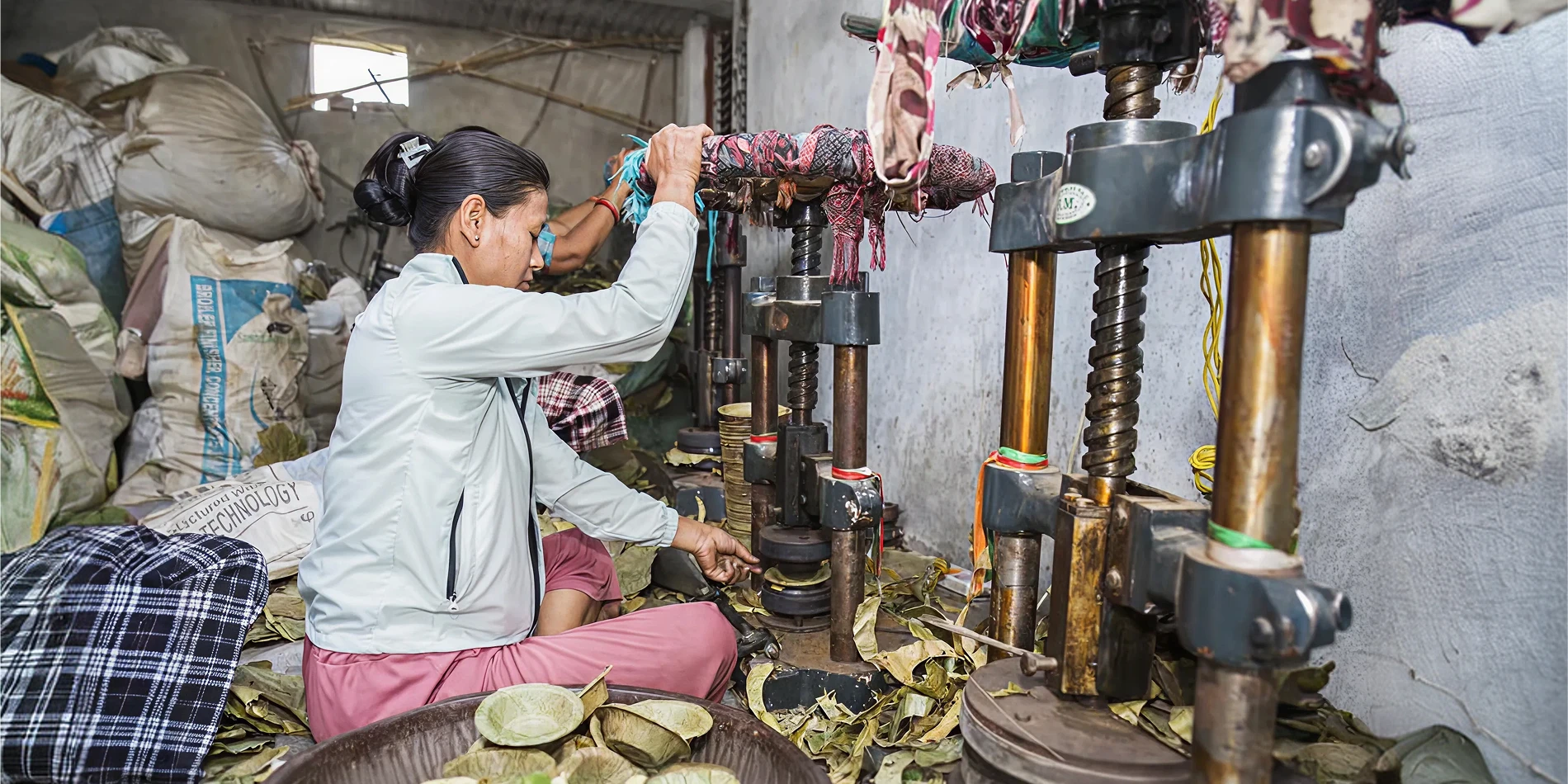
With support facilitated through her ward office, she received NPR 50,000 (approximately EUR 290) to restart her enterprise. But she did not rise alone; she trained 20 women from three different neighborhoods.
Today, Bhawana employs five women full-time. Women from three additional communities earn income by supplying leaves to her enterprise. What began as survival has now become a local value chain.
Building more than a business
During monsoon season, rain once dripped through Bhawana’s thatched roof. Beds were soaked. Her daughter would plead, “Mummy, we are drenched in the rain, please wrap my feet in plastic.”
Piece by piece, Bhawana rebuilt her house using discarded tiles and zinc sheets. Then she gradually built a house. From a hut that leaked, she built a home that stands firm.
“Empowering women entrepreneurs fuels innovation, drives growth, and strengthens communities, and Bhawana serves as a fitting example.”
Her business tells the same story.
In the beginning, she returned from markets with unsold plates. Today, she holds agreements worth 2.5 million rupees (approximately EUR 14.500) with one wholesaler and 2 million rupees (approximately EUR 11.700) with another. Payments arrive instantly on her phone. Production is steady. Demand is growing.
Depending on sales, she now earns enough a month to run her family, pay for her daughter’s school, pay medical bills, and still add some savings to her account.
“This is what women’s leadership in the economy looks like: practical, measurable, transformative, tangible.”
A future shaped by women
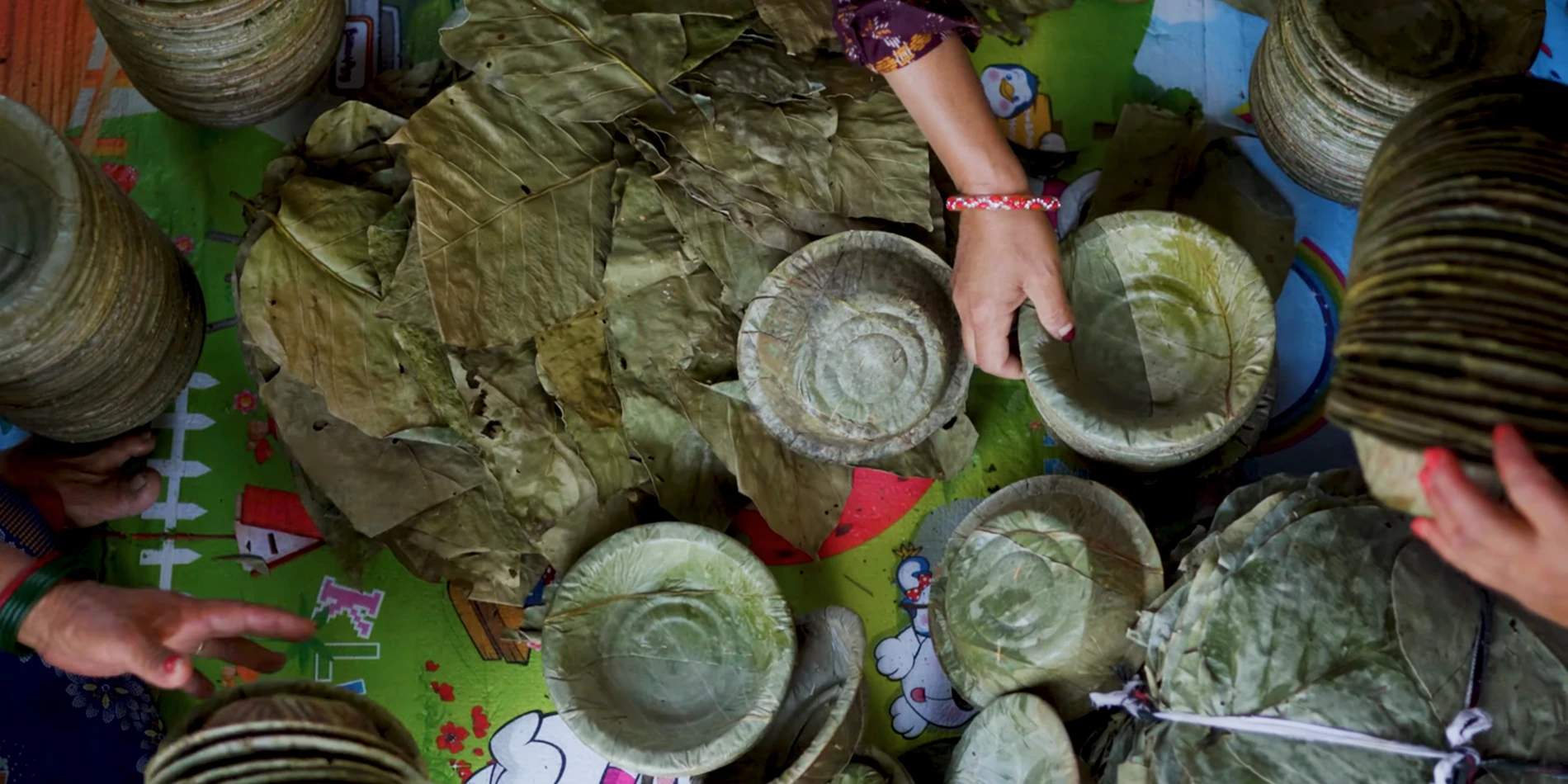
Plastic plates may last a hundred years in the soil. Bhawana’s leaf plates decompose naturally, nourishing the earth.
In the same way, her impact goes beyond income. She has helped create jobs. She has changed perceptions: she has shown young girls in her community that business leadership is possible.
“I have a dream to take this business even further,” she says.
For thousands of women across Nepal like Bhawana, entrepreneurship is not only sustaining families but shaping the nation’s economic future.
Through five decades of partnership, GIZ has supported Nepal and its people to strengthen systems that allow entrepreneurs like Bhawana to thrive, from skills training and market linkages to inclusive economic frameworks under initiatives such as GRAPE 2. But policies and projects alone are not the heroes; women like Bhawana are.
Because when women rise, economies grow. And in the forests of Kailali, that growth begins with a single fallen leaf.